Every property development in Bali depends on zoning: a plot can only host a hotel if the provincial and regency spatial plans allow that use, and no building approval (PBG) is issued without valid zoning conformity (KKPR). You can verify a plot’s zone through the national GISTARU map, the OSS licensing system and the regency’s detailed spatial plan (RDTR).
Bali zoning laws have become stricter since 2025, especially for agricultural land and water catchment areas. An investor who buys land in the wrong zone cannot fix the problem with a better company structure or a longer lease.
This guide explains how Bali’s zoning rules are layered for property development, what the zone colours and codes mean, which building limits apply and how to verify a plot step by step.

| Document | Issued by | What it answer |
| RTRW Provinsi Bali (Provincial Regulation or Perda No. 2 of 2023, covering 2023-2043) | Bali provincial government | Island-wide land-use direction, protected areas, building height |
| RTRW Kabupaten (regency spatial plan) | Regency government, such as Badung | Land-use pattern within the regency, coastal setback lines |
| RDTR (detailed spatial plan) | Regency government | The zone code of a specific area and the activities allowed in it |
| KKPR (zoning conformity) | Issued through the OSS system | Whether a specific activity is allowed on a specific plot |
KKPR is regulated under Government Regulation No. 21 of 2021 on spatial planning. Where an RDTR is already integrated into OSS, conformity can be confirmed automatically. Where it is not, the application goes through a slower assessment.
Zoning maps in Bali use colours to show land-use categories, and investors often describe land by its colour. The colours most often used in property listings are:
| Colour | Usual category | Typical use |
| Green | Agriculture | Farmland, with construction heavily restricted |
| Yellow | Residential | Houses and small-scale accommodation |
| Red | Trade and services | Shops, offices, restaurants |
| Pink | Tourism | Hotels, resorts and tourism facilities |
| Orange | Mixed use | A mix of housing and commercial activity |
A colour is a shorthand, not a permit. Map legends differ between documents, and what decides a plot’s use is its zone code in the RDTR and the KKPR result for the specific activity you plan.

For a starred hotel in Badung, the zone that most clearly fits is the tourism zone, coded W in Badung’s detailed plans and shown in pink. Residential zones are generally limited to small-scale lodging such as pondok wisata, not starred hotels, and mixed-use or trade zones differ in what accommodation they list.
Uluwatu and Pecatu sit in South Kuta (Kuta Selatan) district, Badung Regency. Much of the Bukit Peninsula is cliff and coastline, which further limits where a hotel can be built, as our article on limited buildable land on the Bukit Peninsula explains.
Because zone tables differ between planning areas and are revised over time, check the code for the exact plot in the current RDTR rather than relying on an area’s general reputation.
Zoning also limits how much you can build, not only what. Three rules matter most for property development in Bali.
Since September 2025, converting productive land for commercial buildings in Bali has become much harder. After fatal floods, the governor instructed all regencies and Denpasar on 14 September 2025 to stop approving commercial buildings on rice fields, other productive agricultural land and water catchment areas.
That direction was then placed into law through Bali Provincial Regulation No. 4 of 2026 on controlling the conversion of productive land, which also prohibits transferring land ownership through nominee arrangements. In practice, land already zoned for tourism is in a very different position from farmland that a seller promises can be “converted” for a villa or hotel.
Zoning conformity is the first step in Bali’s permit chain, and every later permit depends on it. The sequence runs from KKPR to environmental review, then building approval (PBG), and finally the certificate of function worthiness (SLF) once the building is complete. A PBG application without valid KKPR is rejected, as our guide to the full hotel permit sequence explains.
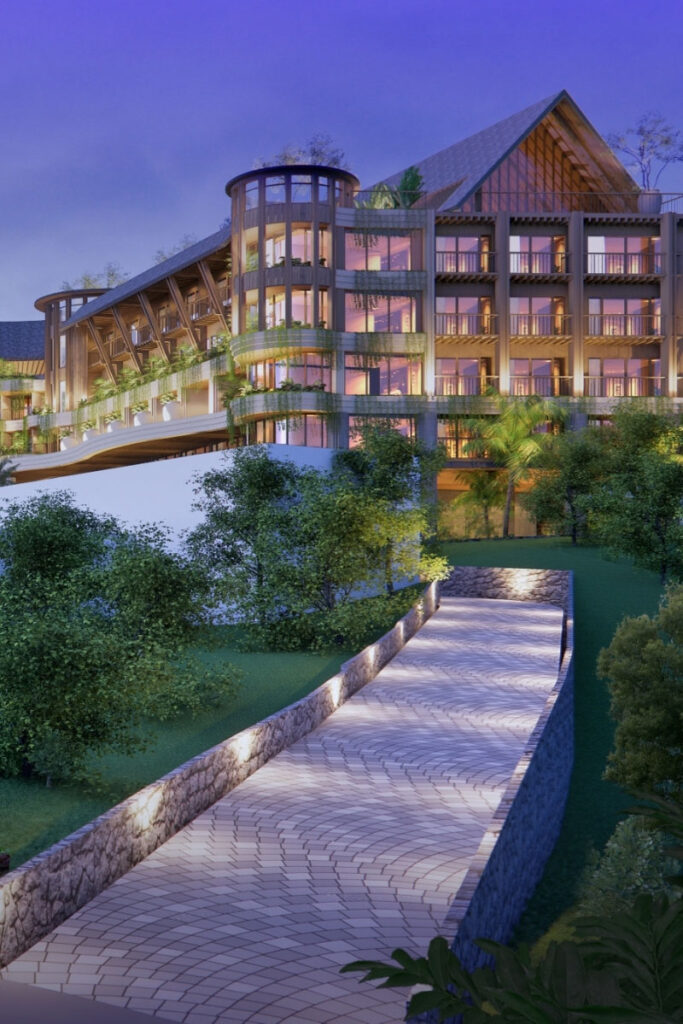
CROSS Bali Uluwatu shows this sequence in practice. The hotel’s site in Pecatu sits within the designated Tourism Zone (W), marked pink on the zoning map, and the project has since secured its building permit and moved into construction. Read more about Pecatu, the location behind CROSS Bali Uluwatu.
Zoning tells you what can be built on a plot, while the land title tells you who has the right to build it. Both have to be correct for a hotel project to work.
A plot in a tourism zone still needs the right holder. For a foreign-backed hotel, that means a PT PMA holding HGB title over the hotel site. The hotel’s scale also affects whether the business is open to foreign ownership, which our article on hotel scale rules for foreign ownership covers.
Follow these six steps before signing any agreement or paying a deposit:
Property development in Bali starts and ends with zoning. The provincial plan, the regency’s detailed plan and the KKPR result decide whether a hotel can be built at all, while height limits, coverage ratios and setbacks decide how much can be built.
Verifying a plot before you buy is far cheaper than discovering a zoning problem at the permit stage. To see how a project looks when zoning, permits and construction are already in place, explore CROSS Bali Uluwatu, located in Pecatu’s designated tourism zone.
No. A hotel can only be built where the regency’s detailed spatial plan allows it, typically in a tourism zone, and the project needs KKPR zoning conformity before a building approval is issued.
Pink is the colour commonly used for tourism zones on Bali zoning maps. It generally allows hotels, resorts and tourism facilities, but the zone code and KKPR for the specific plot are what confirm the permitted use.
Locate the plot on the GISTARU map, check its zone code in the regency’s RDTR, confirm KKPR for your planned activity in the OSS system and have a notary and legal adviser verify the result.
15 metres, under Bali’s provincial spatial plan, with exceptions only for special structures such as towers and public safety facilities.