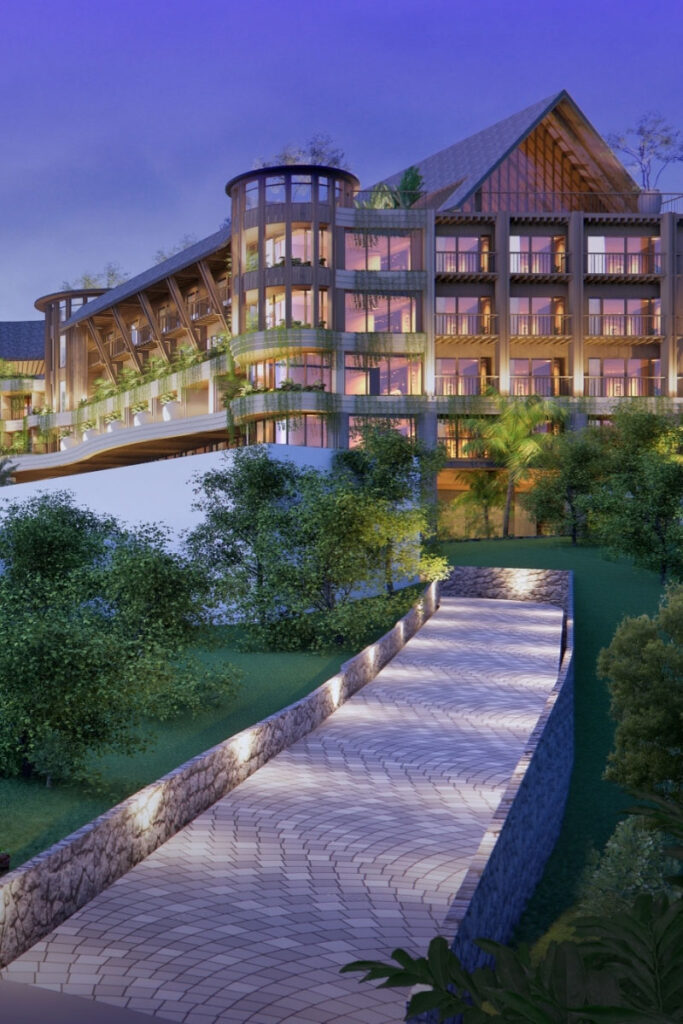
CROSS Bali Uluwatu sits in Pecatu village on Bali’s Bukit Peninsula, roughly 200 metres from Suluban Beach and within a few minutes of Uluwatu Temple, placing it inside one of Bali’s most established luxury and surf tourism corridors rather than an emerging or unproven area.
Location is one of the clearest ways to evaluate a hotel investment’s demand fundamentals, and Pecatu’s mix of surf tourism, temple tourism, and beach club density gives the area a track record most new developments lack. This article covers Pecatu’s geography, its distance to key landmarks including Suluban Beach, and why this specific micro-location matters for a hotel investment.

Pecatu is a village (desa) within South Kuta district, Badung Regency, on the western side of Bali’s Bukit Peninsula. The peninsula’s hilly, limestone terrain creates smaller, more isolated beaches than the flatter coastline at Nusa Dua on the peninsula’s eastern side, a geography that has historically drawn surfers to Pecatu’s coast specifically rather than the broader, more accessible beaches elsewhere on the peninsula.
Uluwatu Temple, one of Bali’s six directional sea temples and a site dating to the 11th century, sits within Pecatu’s territory on a cliff roughly 70 metres above the Indian Ocean. Uluwatu itself is not a separate administrative area but a locality within Pecatu, so references to “Uluwatu” in tourism and real estate contexts generally mean this same village. South Kuta district as a whole covers just over 101 square kilometres and includes six villages spanning the full peninsula, from Jimbaran in the north to Benoa and Tanjung Benoa on the eastern side, with Pecatu occupying the western tip.
That western position matters for how the area developed. Unlike Nusa Dua, which was planned and built out as a government-run resort enclave with flat terrain and centralized access, Pecatu’s limestone cliffs and isolated coves led to smaller, more privately developed beach access points, a pattern that shaped the area’s growth around surf tourism rather than large-scale resort infrastructure from the outset.

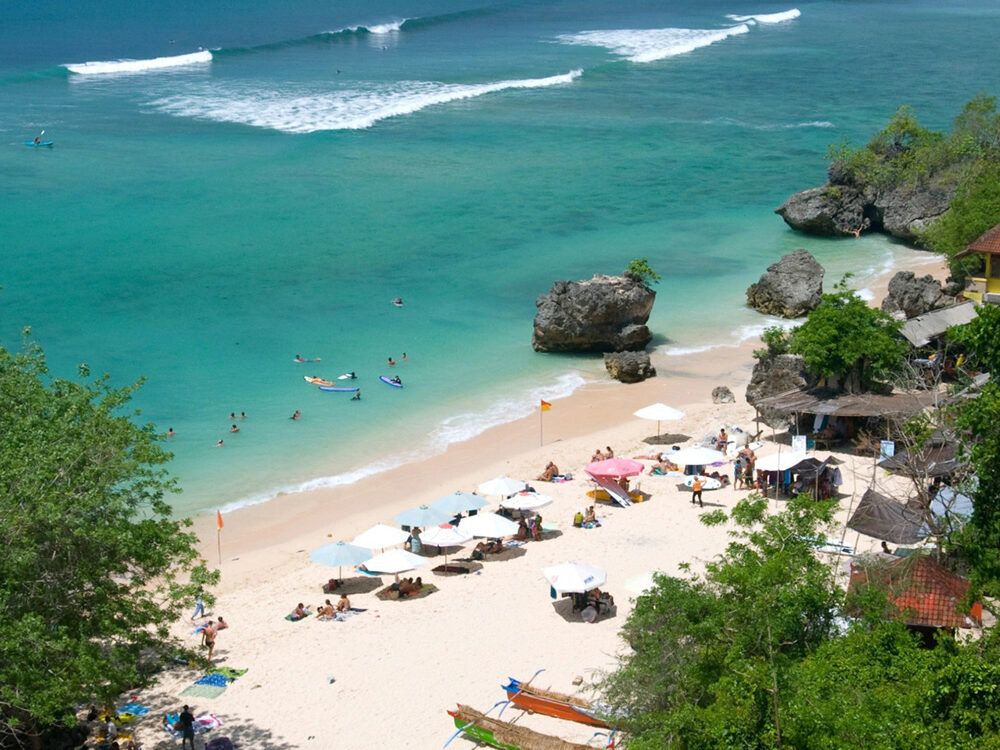
The project sits approximately 200 metres from Suluban Beach, a distance confirmed directly in Cube Bali’s own project materials. Suluban, also known locally as Blue Point, is one of Uluwatu’s best known surf breaks and has drawn international surf tourism to this stretch of coast for decades. The beach itself is accessed through limestone cave entrances at low tide, a physical feature that has become part of its identity among surfers and visitors.
Uluwatu Temple, Padang Padang Beach, and Bingin Beach all sit within a short distance of Pecatu’s coastal strip, though exact travel times vary by the specific access road used, since the peninsula’s beaches are connected by a network of narrower roads rather than a single direct route. Precise distances from the CROSS Bali Uluwatu site to each of these landmarks should be confirmed against the project’s exact coordinates rather than general area estimates, since even nearby beaches on the peninsula can require winding inland routes rather than a direct coastal path.

Pecatu’s coast has carried international surf tourism since at least the 1970s, well before most of Bali’s current hotel development began, and the area’s beach club, dining, and wellness scene has grown substantially around that original surf demand. That combination gives Pecatu a demand history that a newer or unproven development area cannot claim, regardless of how strong that area’s growth projections look on paper.
This matters specifically because hotel investment returns depend on sustained guest demand, not just a compelling design or brand. A location with decades of visitor traffic across multiple demand drivers, surf, temple tourism, beach clubs, and dining, carries less demand risk than a location betting on a single new attraction or an unproven growth corridor. Investors evaluating any Bali hotel project should weigh the location’s actual visitor history against its marketing narrative, and Pecatu’s track record is verifiable independently of any single developer’s claims.
The area’s demand base is also diversified across visitor types rather than dependent on one segment. Surfers travel to Pecatu specifically for its breaks, cultural and heritage tourists visit for Uluwatu Temple, and a separate lifestyle-driven crowd comes for the beach clubs and dining that have developed around both. A hotel positioned here draws from all three streams rather than relying on a single niche audience holding steady.
Bali’s hotel and villa development has expanded well beyond Pecatu and the wider Bukit Peninsula in recent years, with areas such as Canggu, Berawa, Seminyak, and Ubud each carrying their own demand profile. Canggu and Berawa have grown around a digital nomad and lifestyle crowd with a more recently built dining and coworking scene, while Ubud draws a wellness and culture-focused visitor base inland, away from the coast entirely.
Pecatu’s position is distinct from both. Its demand history predates the more recent wellness and digital nomad growth seen elsewhere on the island, and its geography, cliffside terrain with limited flat land, has kept large-scale development more constrained than in flatter areas like Canggu. For an investor comparing locations, that constraint cuts both ways: it limits the pace of new competing supply, but it also means site selection and access within Pecatu itself require more scrutiny than in areas with simpler, flatter road networks.
Ngurah Rai International Airport is the only commercial airport serving Bali, and travel time to Pecatu varies significantly depending on route and traffic. Some transfer operators quote roughly 14 minutes using the Bali Mandara Toll Road under ideal conditions, while general travel guides more commonly cite 40 minutes to over an hour, and up to 1.5 hours during peak periods such as late afternoon when surf and temple visitor traffic is heaviest.
This wide range is worth taking seriously rather than treating one figure as definitive. The Bukit Peninsula’s beaches and attractions connect through a network of smaller roads rather than one direct corridor, so travel time depends heavily on the specific destination within the peninsula and the time of day, not just the distance in kilometres. For an investor, this is worth factoring into guest experience planning rather than assuming airport proximity alone guarantees convenient access.
Pecatu combines walking-distance access to Suluban Beach with decades of established surf and temple tourism, a meaningfully different profile from an unproven location bet. That track record is independent of any single project, which is what makes it a useful reference point when evaluating a hotel investment’s location risk.
Investors can review CROSS Bali Uluwatu’s full site documentation through Cube Bali’s Invest page.
Approximately 200 metres, a distance confirmed in Cube Bali’s own project materials.
Pecatu is a village within South Kuta district, Badung Regency, on Bali’s Bukit Peninsula.
Estimates vary widely depending on route and traffic, from around 14 minutes via toll road under ideal conditions to over an hour during peak periods. Travel time depends heavily on the specific destination within the peninsula.
A multi-decade history of surf, temple, and beach club tourism that predates most current hotel development in the area, giving it a demand track record that newer or unproven locations do not have.
Uluwatu is a locality within Pecatu village rather than a separate administrative area, so the two names are generally used to refer to the same stretch of coast and its surrounding attractions.