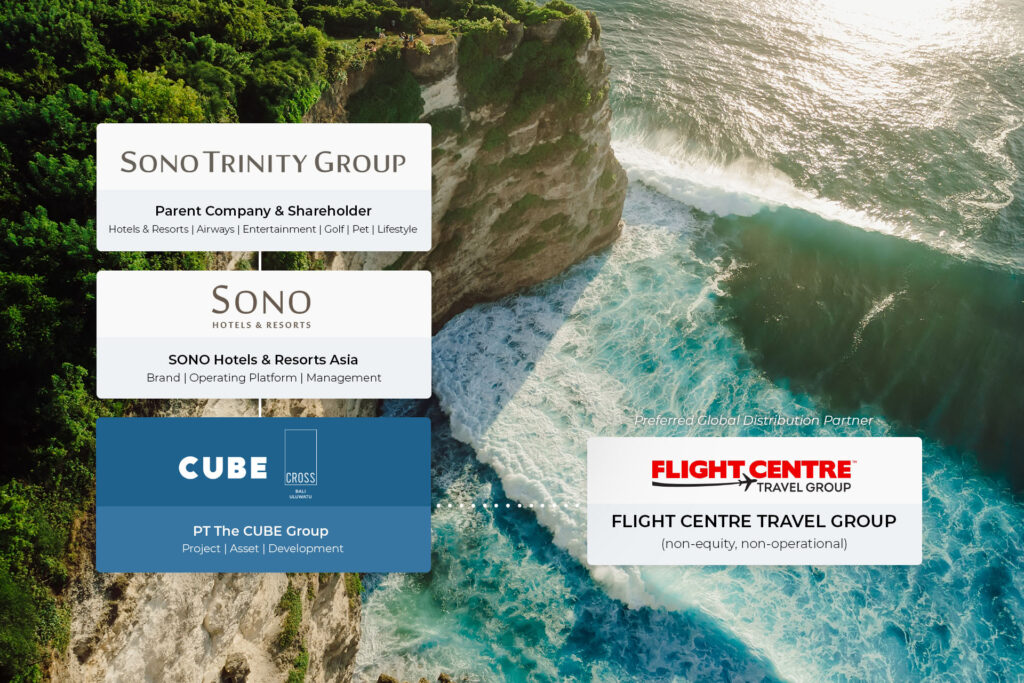
CROSS Bali Uluwatu is operated by CROSS Hotels & Resorts, a hotel brand owned by South Korea’s SONO Hospitality Group, under a 12-year Hotel Management Agreement signed with developer PT The Cube Group in October 2025.
The ownership structure is new. SONO Hospitality Group’s holding arm, SONO International, completed its acquisition of CROSS Hotels & Resorts from Australia’s Flight Centre Travel Group in November 2025, only a month before the CROSS Bali Uluwatu signing. For anyone evaluating the project, the more useful question is not just who owns what, but what that ownership actually delivers for CROSS Bali Uluwatu specifically.
CROSS Hotels & Resorts was, until late 2025, wholly owned by Flight Centre Travel Group (FCTG), the ASX-listed Australian travel company. FCTG decided to sell the hotel management business as it shifted focus to other parts of its portfolio, including its coach and cycle touring operations and destination management services.
In November 2025, FCTG agreed to sell CROSS Hotels & Resorts to SONO International Co. Ltd., a South Korean hospitality group. Graham Turner, FCTG’s managing director, described the sale as a way to cement CROSS’s future within a larger hotel management organization while freeing FCTG to pursue other growth areas. CROSS kept its Bangkok headquarters and its brand portfolio: CROSS, CROSS Vibe, Away, and Lumen.
At the time of the CROSS Bali Uluwatu signing, CROSS Hotels & Resorts operated 16 hotels across Thailand and Indonesia with more than 1,500 keys, according to the official announcement published on the SONO Hotels & Resorts Asia site. The company has stated plans to add more than 9 additional properties across the Asia-Pacific region by 2029.

SONO International is the holding company of SONO Hospitality Group, South Korea’s largest resort operator. In its home market, the group runs hotels and resorts under the Sono Hotel & Resort and Sol Beach brands, alongside ski and water park operations at Vivaldi Park.
Internationally, SONO International’s portfolio spans more than 14,500 operating rooms across 7 countries, including South Korea, the United States, and France, according to Hospitality Net’s organization profile. Its overseas acquisitions include the Normandy Hotel in Washington, D.C., the 33 Seaport Hotel in New York, the Waikiki Resort Hotel in Hawaii, and the Dame des Arts hotel in Paris, its only European property.
Beyond hospitality, SONO International also owns budget airline T’way Air, which it acquired a controlling stake in during 2025 for approximately 250 billion won. For CROSS Hotels & Resorts, the acquisition means access to a larger, better-capitalized parent with an active acquisition track record and a clear stated ambition to grow its Asia footprint.

What this ownership chain actually buys CROSS Bali Uluwatu comes down to two things: lower operator risk and built-in distribution.
An operator backed by fresh international capital and an active expansion mandate carries different risk characteristics than an independent or single-property brand would. CROSS Hotels & Resorts now sits inside a parent group with a demonstrated pattern of overseas acquisitions and a stated regional pipeline target, rather than standing alone as a mid-sized operator with no larger backer to draw on if conditions get harder.
The more immediate benefit is distribution. CROSS Bali Uluwatu opens under a brand that already has an established presence across 16 hotels in Thailand and Indonesia, meaning access to CROSS’s existing guest loyalty base, sales channels, and brand standards from day one, rather than needing to build market recognition from a standing start, as an unaffiliated new hotel typically would.
Both of these are structural advantages, not guarantees. Deal terms and portfolio scale are verifiable facts. Future performance is not, and no return projection should be inferred from the strength of the ownership structure alone.

PT The Cube Group signed a 12-year Hotel Management Agreement, with extension options, alongside a Technical Support Agreement with CROSS Hotels & Resorts in December 2025. The signatories were Dauren Nurgaliev as Director for PT The Cube Group, and Jihong An and Evan Burns for CROSS Hotels & Resorts, witnessed by Mikhail Silyachev and Fenty S. Prawiraatmadja from PT The CUBE Group and top level management CROSS Hotels & Resorts.
What matters for the project is what these terms actually secure, not just that they exist. A 12-year commitment, with the option to extend further, means CROSS is not a short-term manager that can walk away once the property opens; it is locked into the property’s performance for over a decade. That is a meaningfully longer horizon than many single-property management contracts, and it signals that CROSS Hotels & Resorts is treating CROSS Bali Uluwatu as a long-term brand placement in Indonesia rather than a trial engagement.
The Technical Support Agreement matters just as much, arguably more, at this stage. It means CROSS is involved during construction, not only once the property is ready to open, which reduces the risk of standards mismatches, design changes, or operational gaps surfacing late in the build. For a project still under construction, having the eventual operator engaged from the build phase onward is a tangible reduction in execution risk, not a symbolic detail.
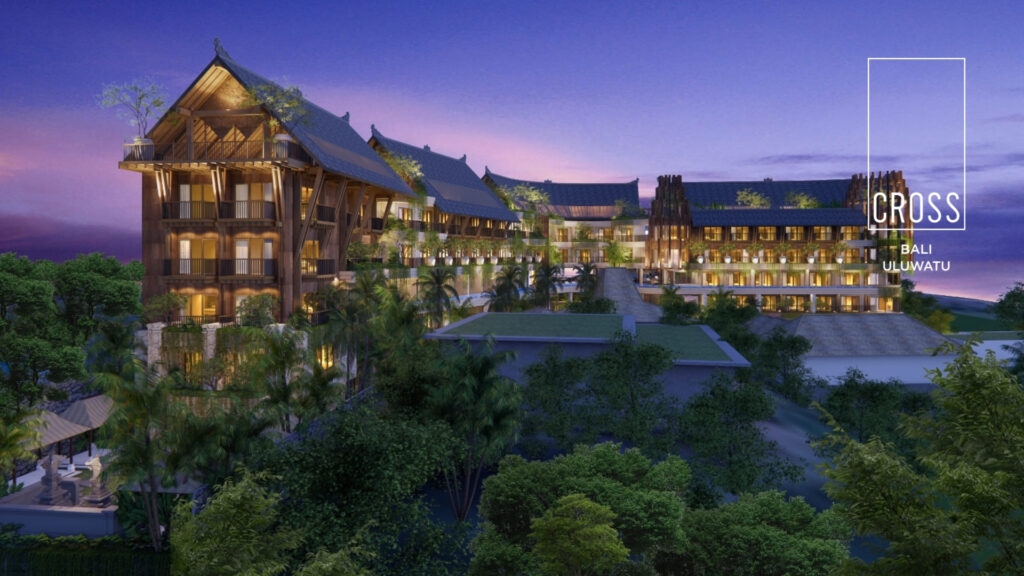
CROSS Bali Uluwatu itself is a 123 key upper-upscale resort located roughly 200 metres from Suluban Beach in Pecatu, Uluwatu, developed under a PT PMA structure with Hak Guna Bangunan (HGB) land title. The full signing agreement between PT The Cube Group and CROSS Hotels & Resorts, covered in the announcement of the CROSS Bali Uluwatu partnership, has more detail on the site and location.
For readers evaluating the project, the takeaway is straightforward: SONO Hospitality Group’s backing gives CROSS Hotels & Resorts more capital and more distribution to work with, and the 12-year agreement with construction-phase support gives CROSS Bali Uluwatu an operator that is committed early and staying long, both of which reduce two of the more common risks in a new hotel development.
CROSS Hotels & Resorts is wholly owned by SONO International, the holding arm of SONO Hospitality Group, following its acquisition from Flight Centre Travel Group in November 2025.
SONO Hospitality Group is South Korea’s largest resort operator, with an international portfolio of more than 14,500 rooms across 7 countries through its holding company, SONO International. It also owns budget airline T’way Air.
PT The Cube Group signed a 12-year Hotel Management Agreement with extension options, plus a Technical Support Agreement, with CROSS Hotels & Resorts in October 2025.
No. CROSS Hotels & Resorts operated under Flight Centre Travel Group for years before the November 2025 ownership change. It currently manages 16 hotels across Thailand and Indonesia.
CROSS positions itself as upper-upscale rather than ultra-luxury, with a portfolio spanning boutique city hotels (CROSS, CROSS Vibe) to more design-focused resort properties (Away, Lumen).
As of the CROSS Bali Uluwatu signing, CROSS Hotels & Resorts operated 16 hotels in Thailand and Indonesia, with a stated pipeline of more than 9 additional properties across Asia-Pacific by 2029.